Wisconsin Parental Choice Program Approved
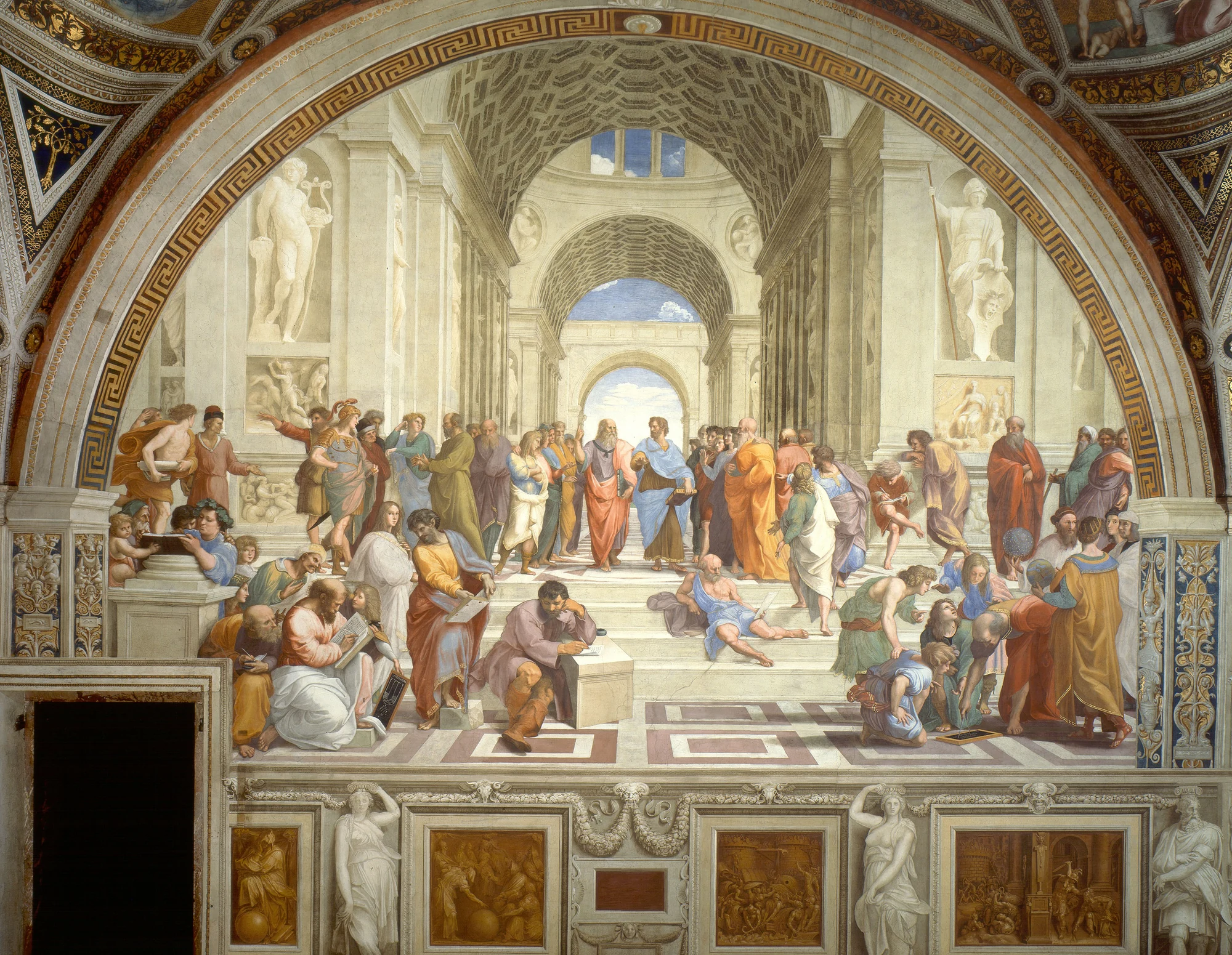
Raphael — The School of Athens
Home/Academics/Classical Education
Classical Education

The oldest education is still the best.

Veritas, bonitas, pulchritudo. Truth, goodness, beauty.

A defense of the liberal arts. The Trivium, the Quadrivium, the Great Books, and the transcendentals — a two-thousand-year tradition of forming the whole person.

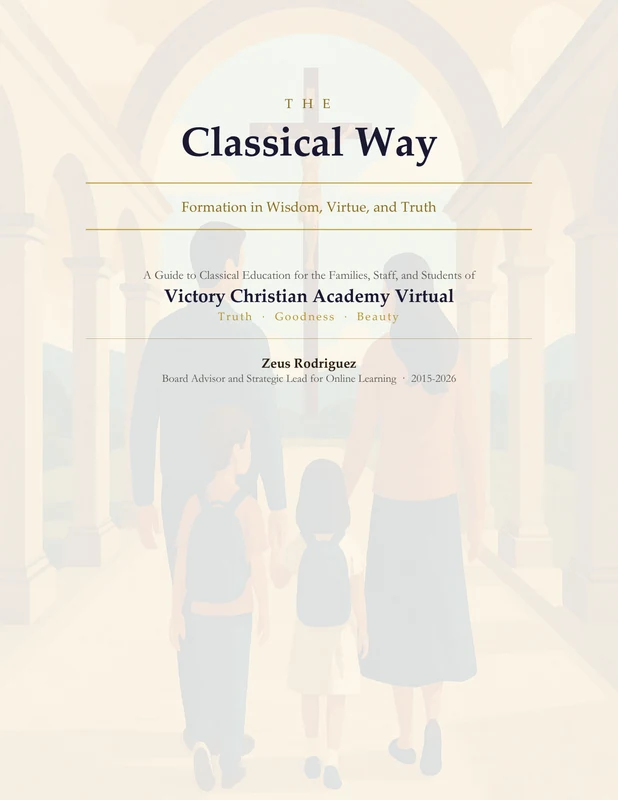
The Classical Way — VCA Virtual primer cover Free PDF
A Defense of the Liberal Arts

A school is what it chooses to teach.

Modern schools chase relevance and credentials. Classical schools train students for a different prize: the formation of a fully human soul.

For two thousand years, the church handed her children a simple inheritance — a course of study built around the seven liberal arts, the Great Books, and the lifelong pursuit of truth, goodness, and beauty. VCA Virtual does not invent this. We recover it. The classical curriculum is not novel; it is older than the printing press, older than the universities of Europe, older even than Rome.

In ordinary terms: classical education is the school your great-grandparents would recognize. Real books read aloud — not chapters in a textbook. Sentence diagrams — not “circle the noun” worksheets. Times tables memorized cold — not “you’ll have a calculator someday.” History taught as a story — not a list of dates. Dinner-table conversation that asks “what did you read today?” instead of “what’s on the test?”

What follows is the philosophy behind it — the convictions that shape every lesson, every reading, every Socratic question. If you want the longer version, download the VCA Classical Primer.

The Three Transcendentals

Truth, goodness, beauty — not opinions, but realities.

Classical education insists that some things are not negotiable. Truth, goodness, and beauty exist outside the human mind, are knowable in part, and are the proper end of every subject taught.

Verum

Truth

Knowledge of what is. The trained mind reasons rightly, distinguishes appearance from reality, and submits to evidence. Logic, mathematics, science, and Scripture all train this faculty.

In plain EnglishWe teach kids to ask “is this actually true?” before they accept anything — including from us. Some things really are true; others really are false. We don’t pretend that’s a matter of opinion.
Bonum

Goodness

Knowledge of what ought to be. The trained will chooses the good, even when it is hard. Virtue is a habit; the classical school is the gymnasium where the habit is formed.

In plain EnglishWe teach kids that some things are right and some things are wrong — and the difference matters, especially when no one’s watching. Character isn’t a “value” or a “mindset.” It’s a habit, and habits get formed.
Pulchrum

Beauty

Beauty is not merely in the eye of the beholder. It is real — and the heart must be formed to recognize it. A formed heart can tell a masterpiece from a manipulation, a true song from a slick one, a real story from a hollow one.

Of the three transcendentals, beauty deserves the longest treatment. Truth and goodness have been maligned in this relativistic age. Beauty has fared worse — misunderstood entirely, reduced to taste, taste to opinion, opinion to identity. Yet beauty may be the very transcendental that still draws people back. A sunset, a Bach cantata, a child’s face — these reach hearts that argument cannot. Beauty is often the door through which truth and goodness still walk in. This is not retreat into the past; it is engagement with the present, with eyes that can see.

In plain EnglishTaste isn’t innate — it’s formed. We hand Scholars Bach, Van Gogh, Psalm 23, the night sky from kindergarten on, not because old is automatically good and new is automatically bad. We aren’t asking your Scholar to live in 1850. They watch movies, listen to new music, scroll the same internet other students elsewhere scroll. The difference: a Scholar whose taste has been formed can tell a thoughtful contemporary novel from a cynical one, a great new film from a manipulative one, a good new song from a derivative one. Trained taste doesn’t reject the modern world — it sees through it. And it learns why some of that world must be refused: certain music, films, shows, and images are made to corrupt — to pull a Scholar away from what is good, true, and beautiful, and to train him to think the opposite is normal. A Scholar formed in beauty learns to recognize them, name them, and walk away on his own.
The Seven Liberal Arts

The Trivium and the Quadrivium.

Seven disciplines, taught in two stages, across twelve grades. The Trivium forms the mind’s relationship to language; the Quadrivium forms the mind’s relationship to number.

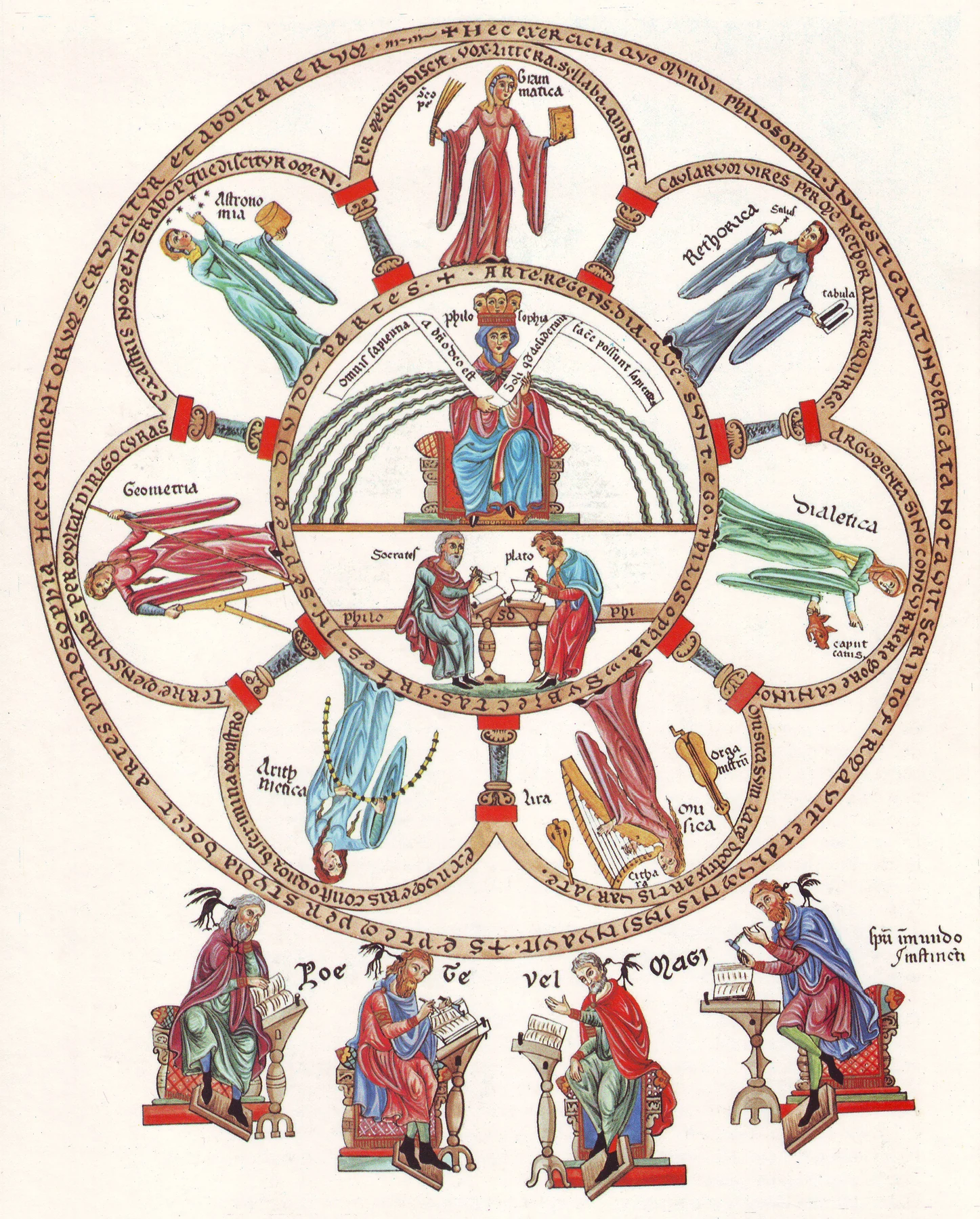
The Seven Liberal Arts — Hortus Deliciarum
Stage I

The Trivium — three roads

Grammatica, Dialectica, Rhetorica

The arts of language. Grammar trains the student to know words. Dialectic (logic) trains the student to think with them. Rhetoric trains the student to speak and write them with truth, beauty, and persuasive power.

  • Grammar — how to read and know
  • Dialectic — how to reason and discern
  • Rhetoric — how to speak and persuade
In a typical weekA 4th-grader might diagram a sentence (grammar), spot a misleading argument in a TV ad (logic), and present a two-minute speech defending a favorite book (rhetoric). Same student, three muscles, classical method. Notice what’s not in there: filling in worksheets, watching a video alone, or hunting for the answer hidden in the passage.
Stage II

The Quadrivium — four roads

Arithmetica, Geometria, Musica, Astronomia

The arts of number. Arithmetic is number in itself. Geometry is number in space. Music is number in time. Astronomy is number in space and time together. The four make a single discipline of contemplation.

  • Arithmetic — the science of pure number
  • Geometry — number in space and form
  • Music — number in time, harmony, and proportion
  • Astronomy — number applied to the heavens
In a typical weekMath taught as a beautiful pattern, not a chore. Geometry that asks “why is this true?” before solving for x. Music as ratio and rhythm. Astronomy as the night sky’s geometry — the same math your Scholar uses on Monday morning, applied to the stars. No “you’ll never use this.” No “just memorize the formula.” Math is the language of how the world works, and your Scholar learns to read it.
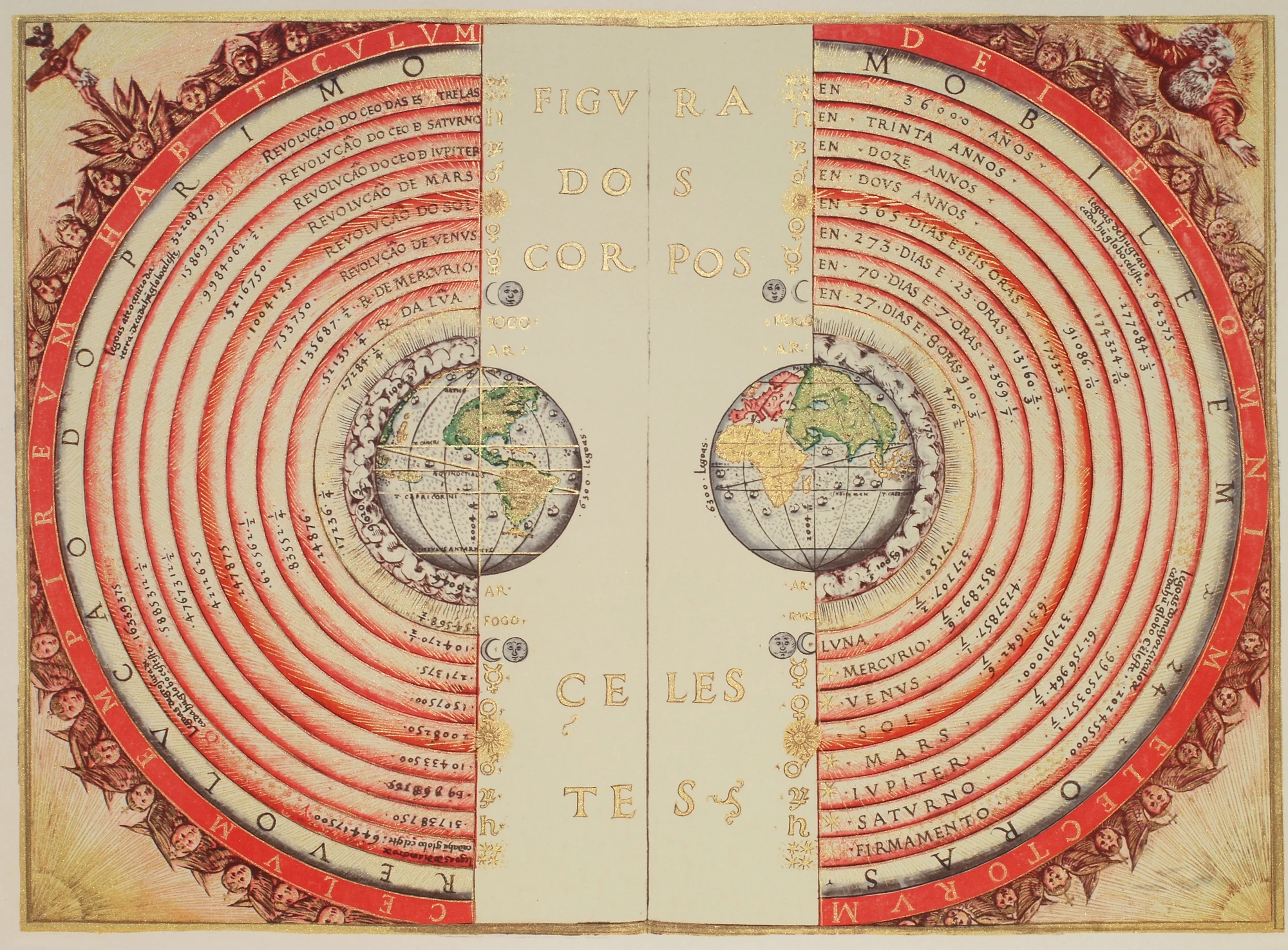
The Ptolemaic spheres — Bartolomeu Velho
Classical, in Real Life

What this looks like in your Scholar’s week.

Less Latin and theory, more concrete: here is what a classical week actually looks like, by grade band, in a real VCA Virtual home.

Grades K–2

“Memorize the song. Sing it back.”

Phonics, nursery rhymes, Bible verses, multiplication chants. Kids this age love to memorize, so we let them. Their minds are sponges; we soak them in beautiful, true things.

Grades 3–5

“Tell me what the story said.”

Latin roots, sentence diagramming, narration of stories read aloud, copywork from the Psalms. Your Scholar learns to listen carefully and play back what they heard — the foundation for everything else.

Grades 6–8

“Why is that argument wrong?”

Logic, formal debate, ancient epic and the great works of the Greco-Roman tradition, classical geometry. Middle-schoolers love to argue. We give them the tools to argue well — and to know when they’re wrong.

Grades 9–12

“Defend your thesis.”

Socratic seminars on Augustine, Shakespeare, Lincoln. Original essays on the moral questions inside the books. Your high schooler walks into college able to read hard texts and write a clear argument.

From a Classical Week

Six phrases you’ll actually hear.

Lines from a normal Tuesday at VCA Virtual. Most parents say they haven’t heard them in a long time.

I

“Memorize the poem. Recite it Friday.”

Memory Work
II

“Read it aloud, please.”

Reading
III

“Diagram the sentence on the board.”

Grammar
IV

“Defend your answer.”

Logic & Rhetoric
V

“What does the text actually say?”

Close Reading
VI

“Times tables. Cold. By March.”

Math

No screens replacing teachers. No worksheets replacing books. No quizzes replacing conversation. The work is the same work that formed Lewis and Tolkien and Aquinas and Augustine. We didn’t reinvent it. We just kept doing it.

The Classical Way — VCA Virtual primer cover
For the Curious Parent

The Classical Way.

Formation in Wisdom, Virtue, and Truth. A guide to classical education for the families, staff, and students of Victory Christian Academy Virtual — written by Zeus Rodriguez, Board Advisor and Strategic Lead for Online Learning.

Download the Primer (PDF) PDF · 27 pages · 34 MB
The Center

Christ at the heart of the classical project.

The classical tradition was carried for two thousand years by the church. It is not a secular project that Christians borrow; it is a Christian project that the secular age has half-forgotten.

“In him are hid all the treasures of wisdom and knowledge.”
Colossians 2:3 · KJV

Truth is one because Christ is one. Goodness is one because Christ is good. Beauty is one because Christ is beautiful. The classical curriculum is the church’s patient, disciplined, joyful confession of this fact — one student, one book, one seminar at a time.

✝︎
“Whatsoever things are true, whatsoever things are honest, whatsoever things are just, whatsoever things are pure, whatsoever things are lovely — think on these things.”
Philippians 4:8 · KJV
Other Paths at VCA Virtual

Classical isn’t the only path. It’s simply the heart.

VCA Virtual delivers two additional non-classical pathways for scholars whose road through the Christian school day looks different.

Begin the Tradition

Two thousand years still teaching.

If you want to see what classical Christian education looks like in practice, the fastest path is the Great Hearts Online Classical pathway — the Trivium, the Quadrivium, and the Great Books delivered live at VCA Virtual.